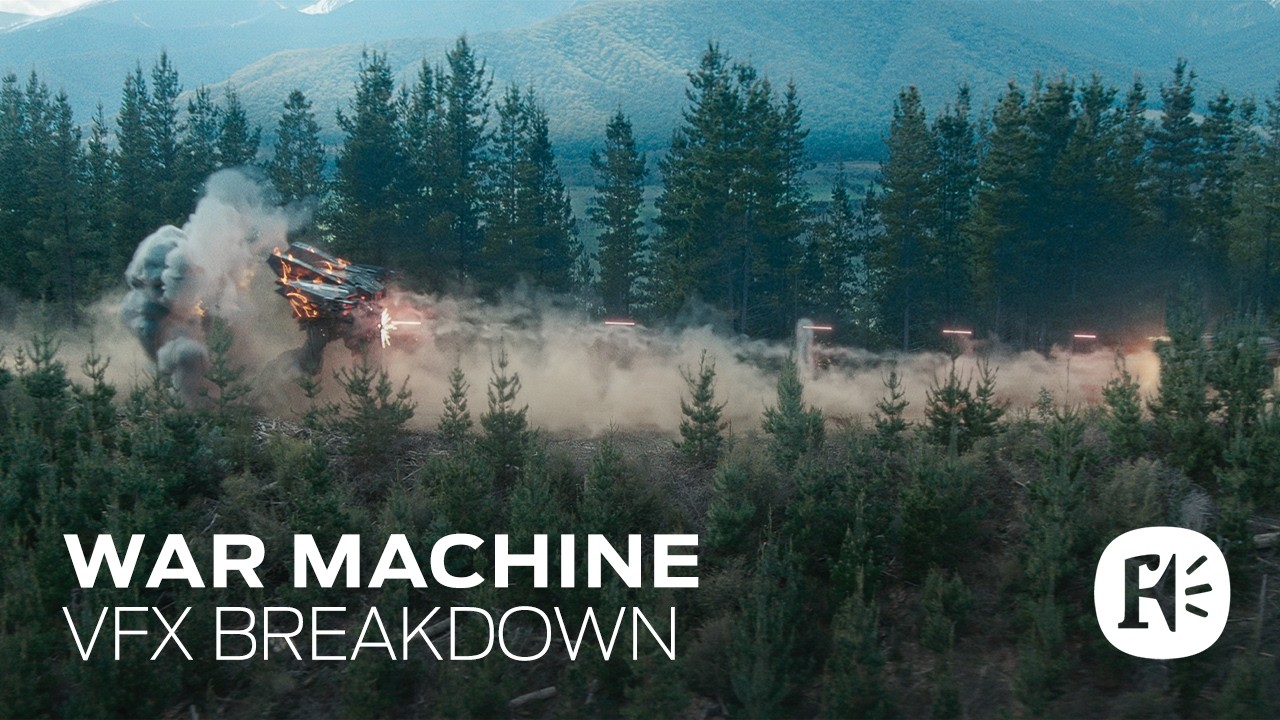
Framestore just dropped a new breakdown reel for War Machine, and it’s the kind of reveal that changes how you watch the movie. That looming alien mech chasing Alan Ritchson’s Army Rangers through the Colorado backcountry isn’t built like a robot at all — the team built it to move, breathe, and hunt like an animal. Here’s what went into it.
What Is War Machine About?
Netflix’s War Machine follows a squad of Army Ranger recruits whose training exercise goes sideways when they stumble on a crashed alien spacecraft deep in the Colorado wilderness. What crawls out is a mechanized killer that starts hunting them across forests, rivers, and rock faces, forcing Ritchson’s character to face down his own past while trying to keep his team alive. It’s less power-armor spectacle and more survival horror with teeth.
Building a Predator, Not a Robot
The creature itself came out of Framestore’s Melbourne and Mumbai studios, and the team’s first move was to stop thinking of it as a machine. They studied dinosaurs and other bipedal animals, stripping away the human-made details — panels, hinges, anything that reads as “engineered” — until the design felt like something built by instinct instead of a factory.
We looked at dinosaurs and other bipedal creatures for inspiration — focusing on weight, imbalance and predatory movement to give it a sense of instinct rather than machinery.
Daniel Fotheringham, Animation Supervisor, Framestore
That instinct shows up in small details, too. The creature “breathes in” the atmosphere around it through a scanning system that reads on screen as sweeping laser light — a nice way to make an alien sensing organ feel readable without a single line of dialogue explaining it.
Six Stages of Getting Hurt
Because the Rangers fight back, the creature had to visibly take damage — a lot of it — without the animation and FX teams rebuilding it from scratch every time. Framestore tracked six separate stages of destruction, each with its own model changes and texture work, including a version with a broken wing that throws off the way it moves. Holding it all together was a flexible “uber” shader that let every department update the look consistently across every damage state, instead of chasing fixes version by version.
From a Colorado Forest to a Quarry Showdown
The environment work had to match the creature’s scale. One standout sequence is a long, unbroken “oner” shot that moves from wide, sweeping landscape all the way into tight, personal detail without a visible cut — a genuinely hard thing to pull off in CG when the camera never stops moving. A late-added ravine sequence expanded the film’s terrain with heavy atmospheric and pyro work, and for the quarry finale, the team went as far as replacing practical excavator footage with a fully CG version so the filmmakers had complete creative control over the final battle.
Layered on top of all that: laser blasts, plasma fire, sparks, dust, and large-scale explosions, all coordinated closely between the effects, lighting, and rendering teams to keep things looking complex without blowing up render times.
War Machine by the Numbers
- 252 shots delivered across Framestore’s Melbourne and Mumbai studios
- 3 VFX houses on the film: Framestore, Rising Sun Pictures, and FIN VFX
- 6 tracked stages of creature destruction, from pristine to devastated
- 1 practical excavator swapped for a full CG double in the quarry finale
Who Built It
Framestore’s side of War Machine was led by VFX supervisor Joao Sita, with animation supervisor Daniel Fotheringham, CG supervisors Sam Doolan, Prashant Nair, and Rakesh Thota, and compositing supervisor Darcy George. On the production side, Raymond McIntyre Jr. served as production visual effects supervisor and Peter Stubbs as special effects supervisor, working alongside Rising Sun Pictures and FIN VFX.

Leave a Reply