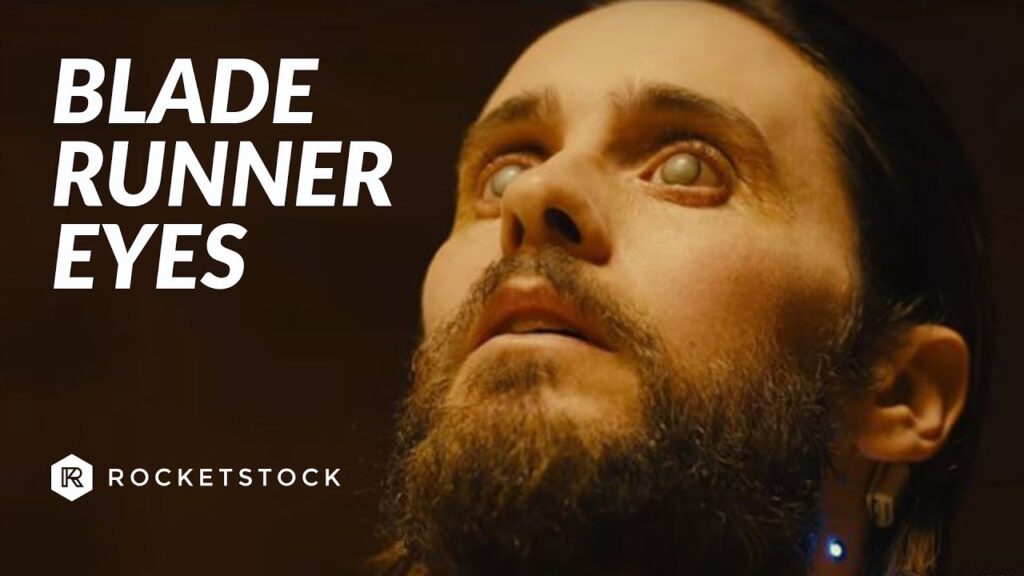
Niander Wallace’s eyes in Blade Runner 2049 are one of the film’s quietest effects. Jared Leto plays a blind man whose sight comes from implants, and the look sells that in about half a second of screen time.
The RocketStock tutorial below rebuilds it in After Effects with no plugins. Project files are included.
What the effect is doing
Two things at once, and both have to be right or the shot reads as a contact lens.
The first is the iris itself. It is too regular. Real irises are messy, asymmetric and slightly different from each other. Wallace’s are clean and matched, which is what tells you they were manufactured.
The second is the absence of focus. His eyes do not track. A normal performance has micro-adjustments as the actor looks at things, and killing that is what makes the blindness land.
Why it works without plugins
Because the effect is small and almost static. The eye occupies a tiny part of frame, the head movement in the shot is limited, and the iris is a flat disc.
That combination means layer effects and a basic track will hold. No mesh warp, no 3D, no third party keyer. The tutorial builds the iris as artwork, tracks it to the eye, then spends most of its time on grading it into the plate.
The grading is the whole trick
This is the bit people skip and it is the bit that matters. An element pasted onto a face at full strength always looks pasted on.
- Match the black levels, because a pure black in your element against a lifted black in the plate is instantly visible
- Match the grain, or the eye will be cleaner than the face around it
- Let the eyelid occlude it, which means a roto pass however small
- Pull the saturation back further than feels right, then a little further
Good practice for a bigger idea
Eye replacement is one of the most common jobs in film and television. Contact lenses are uncomfortable, unreliable on camera and sometimes physically unsafe, so a lot of non-human eyes are done in post.
Learning it on a near-static shot like this one is the sensible order. The same integration thinking applies when the head is moving and the roto gets genuinely hard.
Roger Deakins shot Blade Runner 2049 and won his first Oscar for it. Worth watching the film with the lighting in mind as well as the effects.