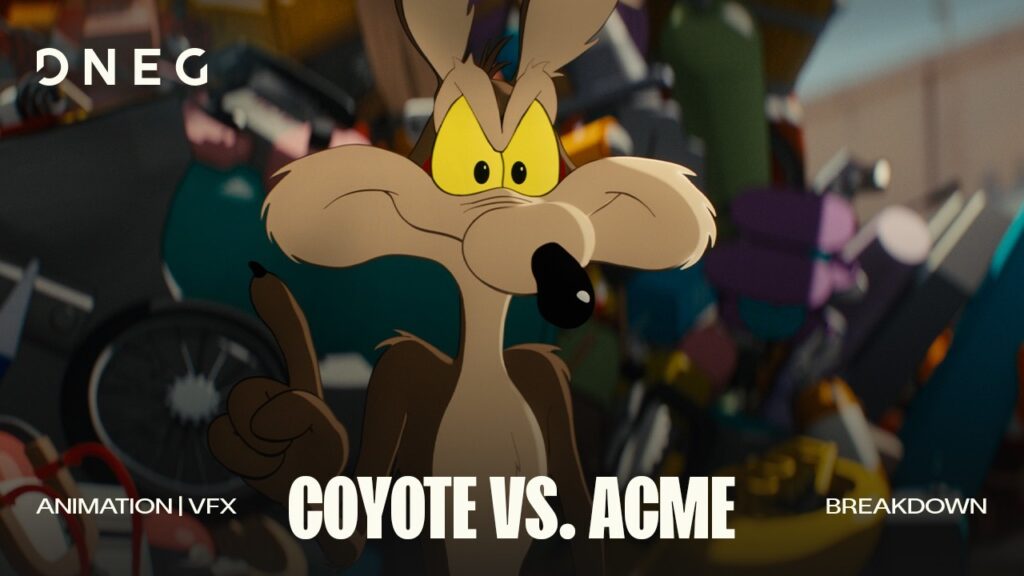
DNEG has released a VFX breakdown for Coyote Vs. ACME, and it is a treat for anyone who grew up on Road Runner cartoons. The reel peels back the layers on how Wile E. Coyote and his doomed ACME gadgets were dropped into real, live-action sets, with plenty of before and after comparisons along the way.
If you have ever wondered how a cartoon coyote can share a courtroom with Will Forte and John Cena without looking pasted in, this is the video to watch.
The film that almost never came out
Coyote Vs. ACME is a live-action and animation hybrid directed by Dave Green. The premise is simple and very Looney Tunes: after years of failed schemes, Wile E. Coyote sues the ACME Corporation over its faulty products. Will Forte plays his human lawyer, Kevin Avery, and John Cena plays ACME’s attorney, Buddy Crane, according to Variety.
The movie also has one of the stranger release stories in recent memory. Warner Bros. Discovery shelved the finished film in 2023 to take a tax write off. Ketchup Entertainment acquired it in 2025 and set a theatrical release for August 28, 2026. We covered the road to release, and the final trailer, in our Coyote Vs. ACME trailer post.
DNEG’s role on the film
DNEG was the lead VFX and animation partner on the movie, as the studio confirmed in its release day news post. The credits it lists give a sense of the scale of the team:
- Production VFX Supervisor: George Murphy
- VFX Supervisors: Alexander Seaman, Jelmer Boskma and Mattias Forsstrom
- Animation Director: Keith Roberts
- Animation Supervisors: Ben Anderson and Alexander Fernandes
That split between VFX supervisors and an animation team matters here. This is not a film where effects simply support the story. The main character is an animated performance, so the animators and the compositors had to work hand in hand on almost every shot.
How a cartoon coyote gets into a real room
Making a 2D style character live in a 3D world is tricky. Editor Carsten Kurpanek explained some of the approach in a Boris FX Art of the Cut interview. He described Wile E. as “a two-and-a-half-D rigged character,” meaning a CG character built to look and move like classic hand-drawn animation. Full hand-drawn animation across the whole film was not affordable, so the rigged character did most of the heavy lifting.
On set, the crew used Wile E. puppets as stand-ins so the actors had something to play against. Kurpanek said they “would shoot a couple of times with Wiley puppets, then remove the puppet” and grab a clean take for the VFX team. Framestore created 3D previs of scenes ahead of time, and hand-drawn key poses were layered over that previs so everyone could see the character’s timing during the shoot.
That is why the before and after shots in DNEG’s reel are so interesting. You can see the empty plate, the puppet or placeholder, and then the finished Coyote, lit and shadowed so he sits in the room with the cast.
What to look for in the breakdown
A few things are worth pausing on as you watch:
- Contact and shadows. Watch where Wile E. touches furniture, floors and people. Those moments sell the illusion more than anything else.
- Cartoon physics in a real space. Squash, stretch and impossible poses still have to sit in live-action lighting.
- The ACME props. Many of Wile E.’s gadgets are CG props, and the before and after comparisons show how they were added to the plates.
- Explosions. Cartoon gags need a payoff, and blowing things up is a big part of DNEG’s work on the film.
If you are new to this kind of video, our guide to what a VFX breakdown is explains how studios build these reels and what the different layers mean.
More viewing on DNEG’s work
For a second angle on the same project, the VFX Wolves channel put together a video titled How DNEG Brought Explosions, Toon Animation & CG Props. It is a third party video rather than an official DNEG upload, but it is a handy companion if you want more time with the props and the effects gags.
Then go back and rewatch the official DNEG reel with the sound off. Without the music and jokes pulling your attention, it is much easier to spot where the puppet ends and the animation begins.
Leave a Reply