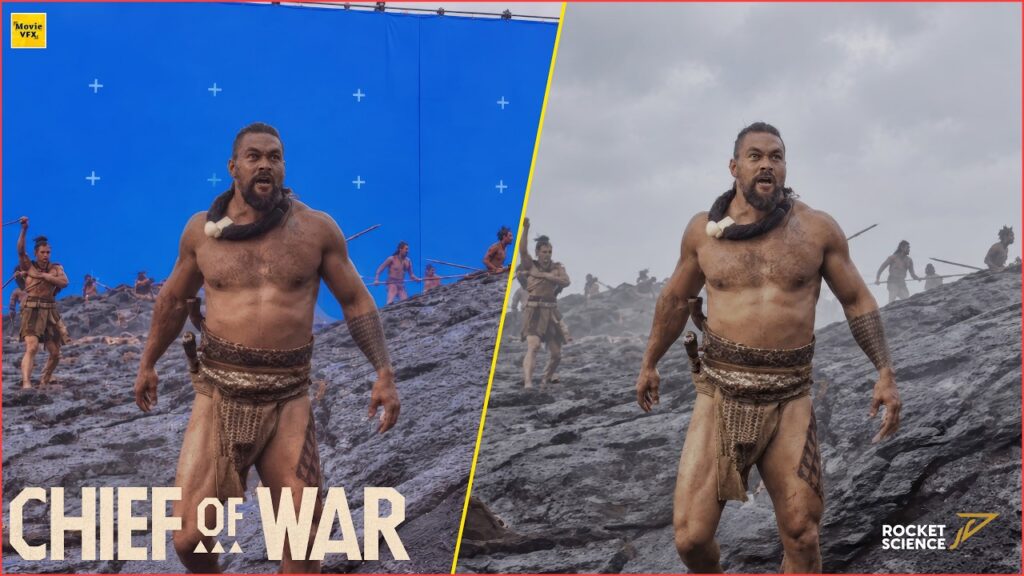
Apple TV+’s Chief of War puts Jason Momoa at the center of 18th century Hawaii. Its battle scenes are some of the most brutal on streaming. This breakdown from Toronto’s Rocket Science VFX (RSVFX) shows how those fights were built. It’s worth studying frame by frame to see how much of each battlefield is real ground and how much is digital.
The reel moves from raw plates to finished shots, so keep an eye on the ground under the warriors’ feet. A lot of the work happens there.
About Chief of War
Chief of War is a nine-episode historical drama. It premiered on Apple TV+ on August 1, 2025, and the finale aired September 19 (release schedule). Momoa co-wrote the series with Thomas Pa’a Sibbett. He also stars as Ka’iana, a celebrated warrior who comes home with new weapons and ideas. Four island kingdoms are at war when he arrives (Popthruster).
Justin Chon directed the first episode, and the cast includes Luciane Buchanan, Temuera Morrison, Kaina Makua and Cliff Curtis. The story is based on true events. It was shot on location in Hawaii with a mostly Polynesian cast.
Who Is Rocket Science VFX?
Rocket Science VFX was founded in Toronto in 2003 by Tom Turnbull and Anthony Paterson, according to the studio’s about page. Its credits include Wednesday, The Boys, IT: Welcome to Derry and Crimes of the Future.
Several of its supervisors have Emmy nominations for shows like Fringe, Hannibal and Wednesday. That TV experience matters here. A show like this means lots of shots, tight schedules and effects that have to hide inside real locations.
Building Battlefields on Volcanic Rock
RSVFX delivered more than 200 battle shots for the series, per the studio’s own write-up. The volcanic ground was filmed in Hawaii. The battles needed far more landscape than any one setup could capture.
To fill the gaps, the team used digital matte paintings (photoreal painted backgrounds). It added CG rock assets and ground sculpts built for individual shots. The goal was continuity. When the edit cuts to a new angle, the terrain has to match what you saw a second earlier.
“We had to customize nearly every shot to match what appeared in the plate and the actors’ choreography,” said RSVFX VFX supervisor Adam Jewett. Production VFX supervisor Chris Scollard was happy with the result: “The team at Rocket Science completely knocked it out of the park.”
Blood, Weapons and Timing
One fight is gorier than the rest by design. For it, the studio built a hybrid blood workflow. CG blood handled the hero moments. 2D elements (pre-shot splashes composited into the frame) covered weapon hits and impacts.
“We had to treat the blood as its own characteristic,” Jewett explained. In other words, the blood got its own design pass instead of being dropped in at the end.
Weapons needed help too. Stunt performers can’t hit each other for real. RSVFX added weapon extensions and adjusted frames so blades and clubs appear to connect. The team also tracked the camera and choreography in each shot. Speed ramps (small changes in playback speed) and plate adjustments kept each fight’s rhythm tight.
More From the Chief of War Crew
RSVFX wasn’t the only studio on the show. New Zealand’s Cause and FX says it handled previs, environment builds, digital doubles and ocean extensions. That work came during the production’s New Zealand phase and included scanned and rebuilt holua sleds.
The video embedded above was posted to YouTube by a channel called Movie VFX. For the studio’s official cut, see the RSVFX reels page. It sits next to breakdowns for Wednesday season 2 and Poker Face season 2.
New to this format? Our guide to what a VFX breakdown is explains how to read the before and after passes. On a second viewing, pause on the wide shots. Look at the horizon and the rock behind the fighters. That’s where most of the matte painting and set extension work lives. For more like this, browse the VFX Breakdowns category.


Leave a Reply