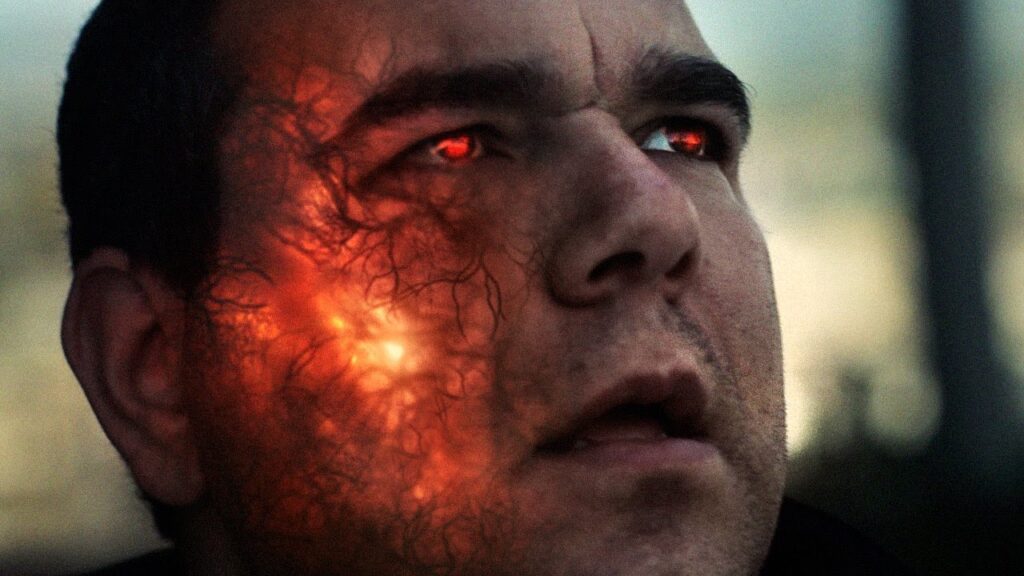
Extremis was the glowing orange effect running under the skin of the enhanced soldiers in Iron Man 3. Andrew Kramer of Video Copilot broke it down shortly after the film came out, and the tutorial below is still one of the better explanations of how that kind of effect is built.
Why this effect is harder than it looks
The glow itself is easy. Anyone can put an orange blur over a face. What sells Extremis is that the light appears to be under the skin rather than painted on top of it.
Skin is translucent. Light entering it scatters sideways before it leaves, which is why a hand held over a flashlight glows red at the edges instead of going black. That behaviour is called subsurface scattering, and faking it convincingly is the whole job here.
The three problems to solve
- Tracking. The glow has to stick to a face that is moving and deforming. A four-point corner pin will not survive a turn of the head.
- Diffusion. The light needs to bleed outward in a way that reads as depth rather than as a soft blur sitting on the surface.
- Interaction. If the skin is glowing, it should be lighting whatever is near it. Skip that and the effect looks pasted on no matter how good the first two steps were.
How the tutorial gets there
It is all built in Adobe After Effects with stacked layers and a tracked plate. No 3D package, no simulation. The glow is generated as its own element, distorted to follow the contours of the face, then pushed back under the skin with blending modes and heavy feathering.
The layering order is the part worth paying attention to. Getting the glow to sit beneath a skin texture rather than over it is a compositing decision, not a plugin.
What has changed since 2013
Tracking has improved enormously. Planar and mesh trackers handle deforming faces far better than they did, so step one takes a fraction of the time it used to.
The rest has not really moved. Selling an in-skin glow is still a matter of understanding how light behaves in flesh and then faking it carefully, which is why a thirteen-year-old tutorial still teaches the right lesson.
Kramer’s prediction in the video was that Extremis would become the most overused effect on YouTube, replacing the demon face. He was not far off.
For more on how shots like this get assembled, see our guide to what a VFX breakdown is and what to look for.