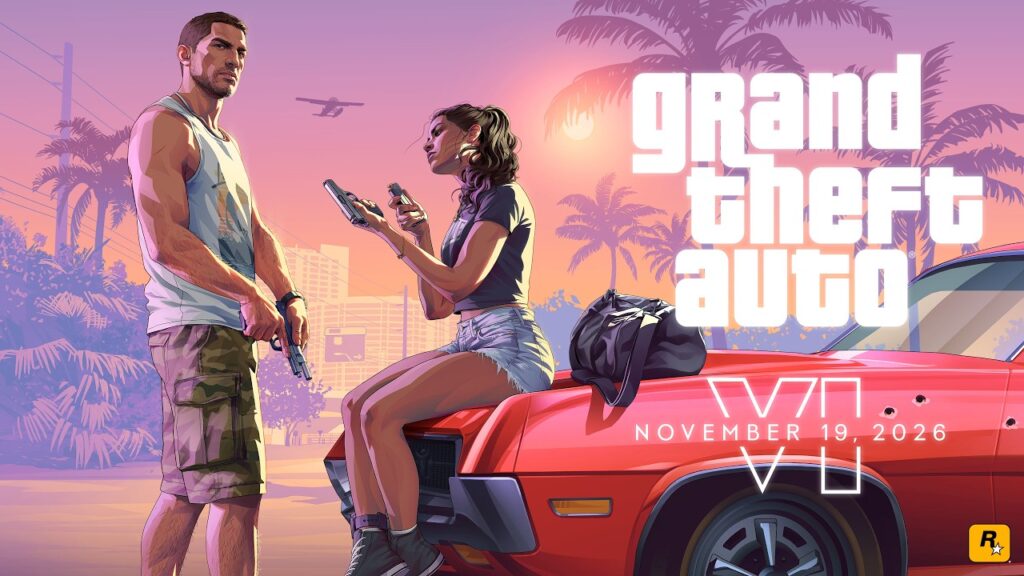
Grand Theft Auto VI lands November 19. Rockstar dropped the launch trailer on October 15. It runs about 90 seconds. It is the last official look before release.
For a VFX site, the story beats are not the headline. The rendering is. GTA 6 is a real-time game doing work that used to need a render farm. Here is what the footage shows, what the tech experts said, and where the downgrade debate stands.
A game that looks like a film
Trailer 1 arrived December 5, 2023. It pulled 93 million views in its first day. Trailer 2 followed in May 2025 and went bigger: 475 million views across platforms in 24 hours.
Rockstar said Trailer 2 was captured entirely in-game on a PlayStation 5. Half gameplay, half cutscenes. Then came Grand Theft Auto VI: An Extended Look, a roughly 27-minute presentation that premiered on Netflix on August 27. Same claim. In-game footage. Base PS5.
That is the detail that matters. No PS5 Pro. No high-end PC. Standard console hardware.
What Digital Foundry saw
Digital Foundry went through the extended look frame by frame. Oliver Mackenzie called it “the most impressive example of real-time game rendering” he had seen. Richard Leadbetter called the result “singular across the entire console generation.”
Their top pick was the characters. DF named the character models the standout visual feature.
Hair got the biggest jump. DF described “huge generational improvements” in hair simulation. That is a big deal. Hair is one of the hardest problems in CG. Film studios can spend weeks on a single groom. Games usually fake it with flat textured cards that fall apart up close.
Skin is the other win. DF singled out sweat and makeup detail. Game skin often looks waxy. Here it reads like a real face under real light. Engadget spotted light filtering through a character’s dreadlocks and catching his jewelry. That is the kind of small light behavior film VFX artists chase on every hero shot.
Characters also change over time. Players can gain or lose weight. Stay awake for days and it shows on the face.
Ray tracing on a console
Lighting carries most of the realism. DF pointed to improved ray tracing throughout the footage. Ray tracing simulates how light travels and bounces. You get believable shadows, reflections and bounce light without an artist faking each one.
It is not flawless. Real-time ray tracing on a console uses fewer rays than an offline film render, so reflections can look noisy in spots. That is the trade-off for doing it live.
Then there is frame rate. Rockstar confirmed in August that both consoles run at 30fps at launch. DF said the frame rate held very steady, with only rare dropped frames. Why not 60? The world is dense. Hundreds of characters, long draw distances and full lighting all cost GPU time. Rockstar picked image quality.
Crowds that feel alive
Vice City needs people. Lots of them. DF praised an “unusually sophisticated NPC ecosystem,” with hundreds of characters on screen at once.
Rockstar has a Los Angeles team focused on NPCs. It built new pipelines and tools to grow the population. Several teams worked on how background characters look, move and react.
Film VFX houses use crowd tools like Massive and Golaem for big battle scenes. Those shots are rendered once and locked. GTA 6 has to do it live, reacting to whatever the player does next. GameSpot’s breakdown of the launch trailer points to packed Vice City beaches with a plane buzzing low overhead.
Leonida is a VFX stress test
Leonida is Rockstar’s take on Florida. It covers Vice City, the Leonida Keys, swamps, at least one national park and a seaside port. Each one is a different rendering problem. Swamp water needs murk and reflections. Beaches need harsh sun and crowds. Vice City nights need neon, wet streets and headlights.
The launch trailer shows Jason wading through swamp water in night vision goggles. That one shot stacks water, darkness and a post effect on top of each other.
The downgrade debate
Not everyone loves the launch trailer. Reddit threads say it looks blurrier and more yellow than Trailer 2.
Is it a downgrade? The evidence says no, at least not yet. Side-by-side comparisons cannot separate the game from the grade. Bloom, depth of field and a warmer color pass can all soften an image. Some fans blamed YouTube compression. Others say the softness also shows up in the file downloaded from Rockstar’s site.
Filippo Tarpini, a former Remedy Entertainment developer, looked at the color. “Gradients are smooth. Skin tones are great,” he wrote. He also spotted odd hue shifts and suspects AgX tone mapping. Blender users know AgX well. It handles blown-out highlights more gracefully than older methods, but it can nudge colors in ways some viewers notice, especially on HDR screens.
Our take: trailers get graded like movies. Judge the game on November 19, on your own TV.
Zero generative AI
Here is the angle VFX fans should care about. Take-Two CEO Strauss Zelnick says generative AI has zero part in what Rockstar is building. Rockstar also says there are no microtransactions at launch.
That stands out in 2026. Film vendors now mix AI-generated shots into feature work, then spend weeks cleaning up flicker and upscaling. Rockstar went the other way. Every street, storefront and palm tree in Leonida was built by artists.
GTA 6 release date, price and platforms
- Release date: November 19, 2026
- Platforms: PS5 and Xbox Series X|S. No PC date yet.
- Price: $79.99 Standard Edition, $99.99 Ultimate Edition
- Physical copies: a download code in the box, no disc. Boxes ship November 12 so you can preload.
As an Amazon Associate we earn from qualifying purchases. See our affiliate disclosure.
GTA 6 visual effects FAQ
Does GTA 6 use ray tracing?
Yes. Digital Foundry noted improved ray tracing across the extended look, which was captured on a base PS5.
Does GTA 6 run at 60fps?
No. Rockstar confirmed 30fps on both PS5 and Xbox Series X|S at launch.
Was GTA 6 made with AI?
Not generative AI. Take-Two says generative AI played no part, and the world is handcrafted by Rockstar’s artists.
The game does use AI in one place: the NPC system. Leaks point to a new RAGE 9 engine paired with Euphoria 2, an updated take on the physics-driven animation tech Rockstar has used since GTA IV. That AI controls how pedestrians move, react and behave. It does not create art, voices or levels. Rockstar has not officially confirmed either name.

Leave a Reply