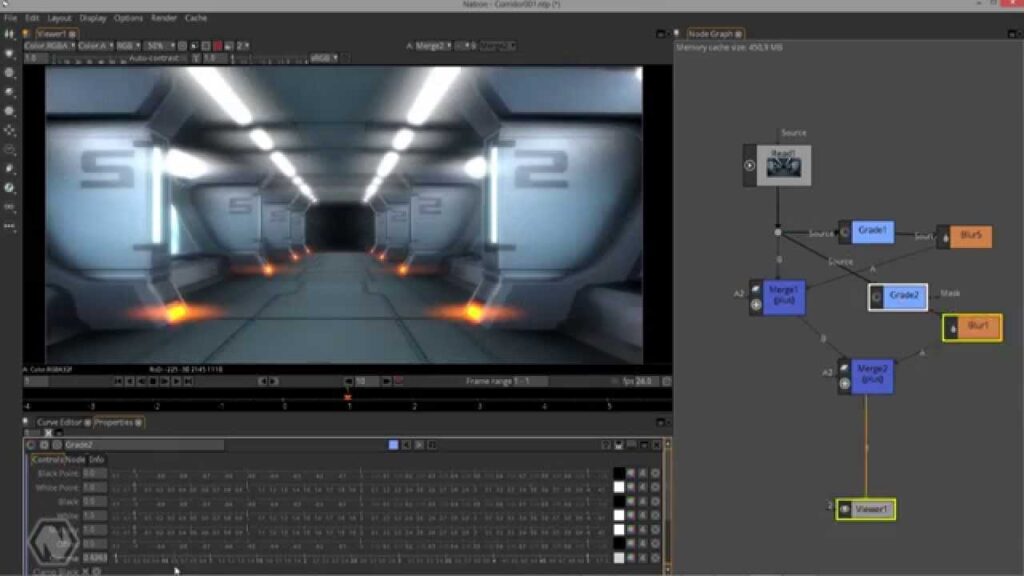
Node-based compositing used to mean a five-figure Nuke license. Today, though, that’s simply not true anymore. Below are five solid node-based compositors you can download and use right now without spending a dime.
1. Natron
Natron is a free, open-source node-based compositor that fills the gap left by pricier tools. Since it supports OpenFX plugins, you’ll find a lot of the same effects here that commercial compositors offer. It also runs on Windows, macOS, and Linux, and an active community continues to maintain it.
2. Blender
Blender’s Compositing workspace is a full node-based system tucked inside software you probably already have open for 3D work. Because Blender includes it natively, you can pull render passes straight from your 3D scene into the compositor without any file exporting, a genuinely nice workflow if you’re already modeling and animating there.
3. Nuke Non-Commercial
The Foundry gives away a non-commercial license of Nuke, the compositor most VFX houses actually use day to day. However, it watermarks the output and caps it at 1080p, and you can’t use it on paid work, but if you want to learn the exact tool a working compositor relies on, this is it.
4. DaVinci Resolve (Fusion page)
Worth a correction from an earlier version of this post: standalone Fusion no longer has a free tier. Instead, Blackmagic Design folded that into Resolve itself and now charges $295 for Fusion Studio on its own. So the free version of Fusion lives inside DaVinci Resolve’s Fusion page, and it’s the real thing: full node graph, 3D workspace, no watermark, no time limit. Studio does add extras like advanced Fusion effects, stereoscopic tools, and multi-GPU rendering, but the free Fusion page is still genuinely usable on its own.
5. Houdini Apprentice (COPs)
SideFX doesn’t market Houdini as a compositor, but it still bundles a full node-based compositing network (COPs) right into it, and Houdini Apprentice is free for non-commercial use. Plus, you get virtually the entire Houdini toolset alongside it, which makes this a solid pick if you want compositing and procedural 3D in the same node graph. The catch: it watermarks renders and caps them at 1280×720, and the free license needs renewing every 30 days.
How They Stack Up
| Tool | Platforms | Commercial Use | Free-Tier Output Limit | OpenFX Plugins | Best For |
|---|---|---|---|---|---|
| Natron | Windows, macOS, Linux | Yes | None | Yes | A free Nuke-style workflow with no strings attached |
| Blender | Windows, macOS, Linux | Yes | None | No (own node system) | Compositing straight out of a 3D/render pipeline |
| Nuke Non-Commercial | Windows, macOS, Linux | No | 1080p, watermarked | Yes | Learning the actual tool studios use |
| DaVinci Resolve (Fusion page) | Windows, macOS, Linux | Yes | UHD 3840×2160 @ 60fps | Yes | Compositing alongside editing and color grading |
| Houdini Apprentice (COPs) | Windows, macOS, Linux | No | 1280×720, watermarked | No (own COP2 nodes) | Compositing combined with procedural 3D work |
All five are free to download today. So, if you need output you can actually sell, start with the two that have no commercial restriction: Natron and Blender. Otherwise, the other three are great for learning the tools before you buy in.




Leave a Reply