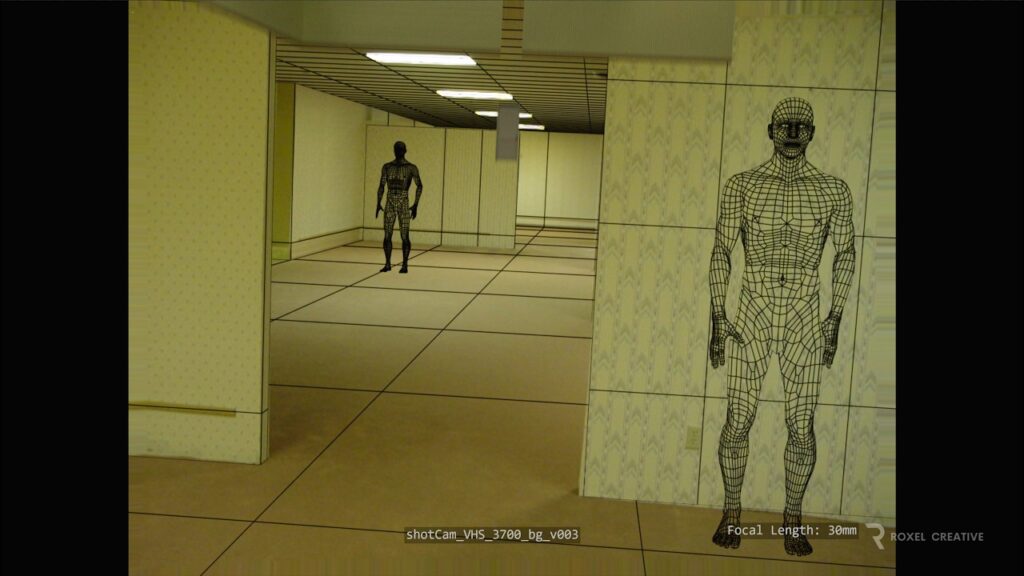
Roxel Creative has dropped its VFX breakdown for Backrooms, and it’s one of the best reels to come out this year. It covers the full CG found footage opener, a suburban street alleyway, CG extensions to the built sets, and the Vertigo Room, which is the standout.
Roxel is Calvin Romeyn’s vfx studio. Romeyn was also the associate VFX supervisor on the whole film, so this reel comes from someone who worked across every part of the show, not just one vendor’s batch of shots.
Directed by Kane Parsons. VFX supervisor: Edward J. Douglas. Associate VFX supervisor: Calvin Romeyn. VFX by Roxel Creative.
A quick recap if you missed it. Backrooms is Kane Parsons’ feature debut for A24. It grew out of his Kane Pixels YouTube series, which grew out of a 2019 4chan photo of an empty, yellow-lit room. The film opened May 29, 2026 and took more than $81 million in its first weekend on a $10 million budget. That was the biggest opening ever for an original horror film. It has since passed $350 million worldwide and is now A24’s highest grossing release. It started streaming on HBO Max on September 25.
Parsons was 17 when A24 hired him to direct and 20 when he made the film. That opening weekend also made him the youngest director ever to have a number one film at the US box office.
The numbers behind the VFX
Edward J. Douglas laid out the totals in an interview with VFX Voice. They’re big for a film this size.
- 830 shots in the film, 600 of them with VFX
- About 1 hour 18 minutes of screen time with effects work in it
- 10 minutes of full CG, including the found footage opener
- 11 outside vendors plus an in-house team
- About 30,000 square feet of practical sets across four sound stages
- About 100,000 square feet of Backrooms that Parsons had designed digitally
That’s more than seven out of every ten shots. Most of them are hard to spot, and that was the plan. Douglas describes VFX as the set of tricks a film needs for whatever it can’t photograph for real.
Roxel Creative and Calvin Romeyn
Romeyn is a VFX artist, writer and director based in Vancouver. He spent five years at ILM, where he worked as a lead compositor, then helped launch Niche VFX. He founded Roxel Creative after leaving Niche. Backrooms is Roxel’s first major project.
Romeyn and Douglas worked together on Osgood Perkins’ Longlegs and The Monkey, and when Douglas signed on to Backrooms, Romeyn was the first person he called, according to Collider.
Roxel’s role went beyond its own shots. Romeyn ran the Blender 3d side of the pipeline. That meant taking Parsons’ digital environments, getting them ready for production, and coordinating with the other vendors who needed to use them.
Blender 3d at the core of the pipeline
Parsons started building his version of the Backrooms in Blender when he was 16. Those files didn’t get shelved when A24 came in. Douglas told VFX Voice that on certain shots the team worked straight from the Blender file Parsons made as a teenager. They upgraded it to cinema quality and moved it into the production pipeline.
On most films, a director’s early 3D work is reference at best. On this one it was source material.
Parsons also stayed in the files through post. Romeyn told Collider that Parsons had remote access to workstations over Parsec. He’d log in during the day or late at night to adjust a camera or swap in an asset he’d found. Douglas made the same point to VFX Voice. When the director can make a change himself, it lands closer to what he wants, and faster, than a note passed from director to supervisor to vendor and back.
Romeyn went through the whole Blender workflow in a talk at the Blender Conference, BCON26. It’s on Blender’s YouTube channel and makes a good companion to the reel.
The found footage opener
The film opens on tape. Async researchers move through the Backrooms with a camcorder, and the footage looks like something pulled from a 1990s evidence box. Douglas counts this sequence as part of the film’s 10 minutes of full CG, and it’s one of the main pieces in Roxel’s reel.
It wasn’t always found footage. According to Collider, the opening was first shot as a widescreen cinematic scene, then switched late in the process to 4:3 VHS. The change helped the budget. Low-res tape can’t hold the fine detail of a 4K render, so the team could stop chasing detail nobody would ever see.
The VHS look in the film is not a plugin. Douglas told VFX Voice that all of it went through a real VHS machine, including frame rate conversion, tape speed and tracking. Parsons also used a hardware distortion box, wired between the computer and the tape deck, to push glitches into the signal by hand. None of the degradation was simulated in software.
That’s a step past how the YouTube shorts were made. Our earlier piece on Parsons’ Blender workflow covers the original series. The feature keeps that look but runs it through actual analog gear, so the artifacts break up and roll the way real tape does.
The Vertigo Room
This is the section most people will rewind. The Vertigo Room is one of the named areas inside the film’s Backrooms. It’s built around an Escher-style staircase that climbs toward the ceiling.
Production designer Danny Vermette told Galerie that the parts the actors interact with were real: the entrance, the ledge, the staircase and the ceiling. They were shot with blue screen underneath. Roxel built the rest of the room in CG, and CG Channel describes the finished space as a full CG environment.
The split makes sense. The cast gets solid ground to stand on and real geometry to react to. The camera gets a room that falls away further than any stage could. The hard part is the join. The CG has to match the wallpaper, the carpet and the flat fluorescent light of the build exactly, or the edge of the set gives itself away.
Things to look for when you watch that section:
- Where the built ledge ends and the CG takes over
- How the fluorescent light falls off as the room drops away
- How the staircase holds its perspective as the camera moves
- How the wallpaper pattern carries across the join between set and CG
Matching a photo from 2003
Everything in Backrooms traces back to one image. The photo that started the creepypasta was taken in 2003 inside an empty furniture store in Oshkosh, Wisconsin, then posted to 4chan in 2019. It’s no accident that Clark, the lead in the film, owns a furniture store.
The production went back to that image on purpose. Vermette told Galerie the film’s wallpaper was designed to resemble the wallpaper in the photo. Douglas told Gold Derby that the VFX team also reverse engineered the original photo, and that the walls in it weren’t actually yellow. The yellow everyone remembers came from the light and the camera, and the film had to recreate that feeling rather than just paint the walls a color.
Set extensions and exteriors you didn’t notice
Parsons designed roughly 100,000 square feet of Backrooms. Production built about 30,000. VFX covers the difference. Roxel’s reel shows several of its CG extensions to the practical sets, where hallways carry on well past the stage walls. Mr. Wolf VFX handled much of the film’s other set extension work.
Douglas told VFX Voice the goal was for nobody to be sure which was which. Some moments that look like Parsons’ Blender world are actually sets. Some that look built are CG.
The reel also covers exteriors that don’t read as effects shots at all, including the suburban street alleyway sequence. The film is set in 1991 San Jose but was shot in Vancouver, so most exteriors got digital work. The team swapped modern Vancouver skylines for period San Jose views and adjusted skies and clouds, pushing the outside world toward a slightly uncanny, dreamlike look.
Previs and stuntvis
The reel closes out with previs and stuntvis. Previs blocks out shots and camera moves before filming. Stuntvis does the same for stunts and action beats, so the stunt team and camera crew can plan around exact timing and positions.
Parsons was involved at this stage too. Douglas told Gold Derby he had never worked on a film where the director built the previs himself. For a director who came up making his own 3D shots, planning the film in 3D first was the natural way in.
The rest of the VFX team
Roxel’s reel is one slice of a big job. Here’s how the other main vendors split the work, based on Douglas’ interview with VFX Voice.
- Mr. Wolf VFX did the no-clipping shots, where characters pass through walls. Actors walked through real gaps in the set, movable walls were added back around them with a mix of rotomation, intersection work and hand roto. Douglas said the CG shadows on the walls made it work: “the shadows and how those shadows appeared is what sold the effects.”
- Zoic Studios built Pirate Clark’s CG face. The 8.5-foot character was played by Robert Bobroczkyi with puppeteer Richard Darwin, and Zoic built the face from a detailed scan of Chiwetel Ejiofor.
- Stormborn VFX handled the water sequence and the destruction of Mary’s childhood home. The excavator smashing through the wall is a full CG simulation of the house interior and its furniture, since the production couldn’t wreck a real house.
- CoSA VFX did the Threshold Chamber. Only the door and the floor were built. The rest came from Parsons’ original Blender model, the one location carried over from his YouTube series.
- The Still Lifes were mostly practical prosthetics from Werner Pretorius and Amazing Ape. On the striped-shirt Still Life, VFX replaced the extra glass eyes with CG ones and made them blink in an offset cascade whenever the actor blinked.
The full vendor list also includes Barnstorm Visual Effects, Shapeshifter VFX, OscarFX, Rotomaker, Beyond Performance Capture Studios and Industrial Pixel 3D Studios.
Some of the smaller fixes are just as telling. In Clark’s pirate commercial, his peg leg is entirely CG, because hopping around on a real one and then dropping into a collapsing chair wasn’t safe. The team did a pants replacement and added the leg in post. And in the shots where Pirate Clark grabs at Mary during the final fight, the gloved hand reaching in is Douglas himself, shot as a separate VFX element.
A Blender 3d pipeline at feature scale
Most breakdowns show big studios doing big studio work. This one stands out because of where the core assets came from. A self-taught artist built a world in a free 3D package, and a team of professionals took those same files and scaled them up to a 600-shot feature instead of starting over.
For Blender users, that’s the useful part. The reel shows Blender work holding up at feature quality, cut together with shots from ten other vendors. For anyone studying compositing, the Vertigo Room is a clean example of a practical build and a CG environment meeting at a hard edge.
More Backrooms VFX to watch
- Mr. Wolf VFX’s breakdown of the set extensions and no-clipping shots, which we covered in August
- Romeyn’s BCON26 talk on the Blender pipeline, embedded above
- The A24 4K and Blu-ray release, which includes a 16-minute VFX and scene breakdown with Parsons, two more VFX breakdowns with optional commentary, and a commentary track with Douglas
- A full befores & afters magazine issue on the film’s VFX, due soon
For more reels like this one, browse the VFX Breakdowns category, or read our guide to what a VFX breakdown is and how one gets made.
Leave a Reply