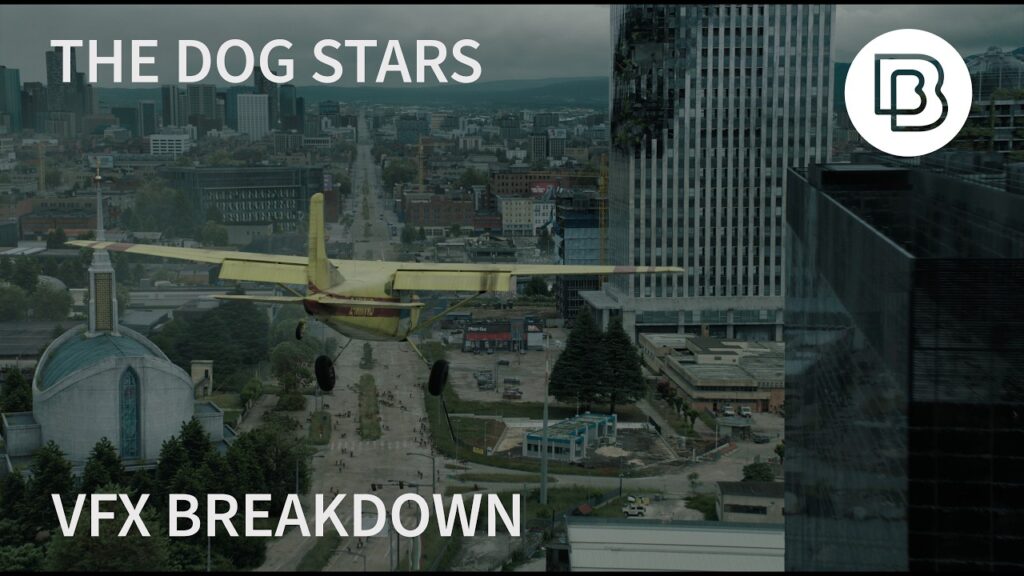
BlueBolt has released its VFX breakdown for Ridley Scott’s The Dog Stars, and it’s a great watch if you like invisible effects. The reel walks through how the London studio turned Italian filming locations into an abandoned, post-pandemic Denver and helped put a small Cessna in the sky over it.
The film is based on Peter Heller’s 2012 novel and stars Jacob Elordi, Josh Brolin, Margaret Qualley and Guy Pearce. It opened in US theaters on August 28, 2026 through 20th Century Studios, with Charley Henley as production VFX supervisor.
Building a Denver nobody lives in
BlueBolt delivered 92 shots between May and December 2025, led by VFX supervisor Henry Badgett, who also ran the studio’s work on Scott’s Napoleon. The production shot in Italy, so every view of Denver had to be added later. As AWN reports, the goal was “a Denver that is recognizable yet abandoned.”
Instead of painting the distant city as flat matte paintings, the team built most of it in 3D. That choice let them move the camera freely, including for aerial views. According to CG Channel, the build used more than 180 assets, from buildings to wrecked cars and street furniture, with around 1,600 building variations filling the wide shots.
Badgett told The Art of VFX that “the horror of this post-apocalypse is connected to Denver being a real and specific location,” and that “every hero building we added had a ‘mother’ in the real world.” The pipeline ran on USD with Maya and Arnold.
Small details that sell the passage of time
An empty city looks fake if it’s too still or too clean. BlueBolt layered in weather staining, dust, broken windows, cracked roads and glitching digital displays. Then they added motion: swaying trees, flapping shutters, traffic lights and plastic caught on telephone wires.
Nature is slowly taking over, too. The overgrown “living buildings” took inspiration from real vertical forests like Milan’s Bosco Verticale and a similar project in Chengdu. Watch the backgrounds closely in the reel, because most of this work is designed so you never notice it.
The Cessna was real, the cockpit often wasn’t
For the flying scenes, BlueBolt stitched together helicopter array footage and extended the environment around it. Bluescreen cockpit shots got digital wings, tail sections and instrument details, plus added stabilization or vibration so the plane felt like it was moving through real air.
A CG cockpit was used where the lighting needed to change, with animated sunlight sweeping across the interior to suggest turns. One fun fact from Badgett: “Amazingly, exterior Cessna shots were never CG Cessna.”
RISE handled the airfield, the Reapers and night vision
BlueBolt wasn’t alone. RISE delivered 218 shots from May 2025 to February 2026, led by VFX supervisor Stuart Bullen and VFX producer Michelle Cullen. In their Art of VFX interview, they explain the main jobs:
- Erie Airpark: the runway was extended, and an overgrown football pitch, bleachers, planes, debris and extra vegetation were added. Bullen said, “The idea is not to overplay the environment with death and destruction.”
- Reaper attacks: crowd replication, plus extra elements of Reapers climbing and running shot by a splinter unit.
- Night vision: a look mixing night and heat vision, with dropped frames, sensor burn trails, a green to orange palette for hot areas and a custom HUD.
- Watchtower collapse: the practical tower fell on a pivot rig, and RISE sped up the fall, added Reapers and built the explosion in Houdini.
Bullen also mentioned Scott’s famous sketches: “Having these Ridleygrams helped portray how haunting he needed this to look.”
If you’re new to reels like this, our guide to what a VFX breakdown is explains the before and after format, and our VFX Breakdowns category has plenty more to explore.
Leave a Reply