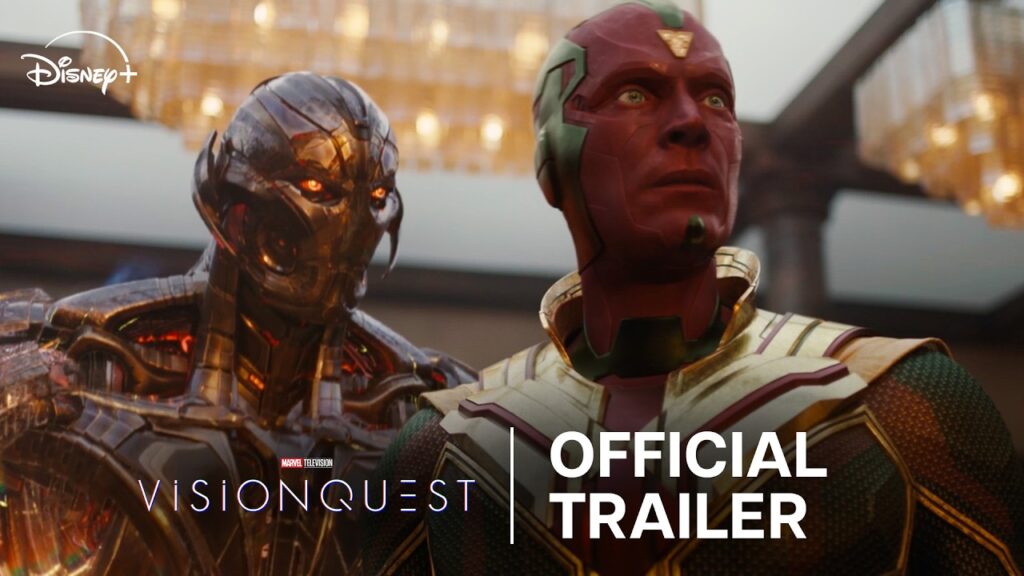
VisionQuest is down to its last episode. Marvel’s eight-part finale to the WandaVision trilogy aired episode 7, “Immolation,” on November 3. Next, the finale, “Forever,” lands on Disney+ on November 10 at 6 p.m. PT. So this is a good moment to look at how the show was built, because most of what works on screen comes down to a few smart visual effects calls.
Paul Bettany is back as Vision, and James Spader returns as Ultron for the first time since Avengers: Age of Ultron in 2015. This time, however, Ultron spends most of his screen time wearing Spader’s own face. Meanwhile, the show’s biggest set lives inside Vision’s head. Below, we break down that set, the Ultron decision, the ten studios on the show and how the reviews are shaking out.
In this article
VisionQuest at a Glance
- Creator and showrunner: Terry Matalas (Twelve Monkeys, Star Trek: Picard)
- Episodes: 8, with Matalas writing episodes 1, 2 and 8 and directing the last two
- Other directors: Christopher J. Byrne, Gandja Monteiro and Vincenzo Natali
- Cast: Paul Bettany (Vision), James Spader (Ultron), Ruaridh Mollica (Tommy), Todd Stashwick (Paladin), T’Nia Miller (Jocasta), James D’Arcy (J.A.R.V.I.S.), Orla Brady (F.R.I.D.A.Y.) and Emily Hampshire (E.D.I.T.H.)
- Production VFX supervisor: John Haley. Production VFX producer: Tricia Pifer
- Schedule: episodes 1 and 2 premiered October 13, pairs followed on October 20 and 27, and episode 7 arrived November 3. The finale streams November 10
Where the Story Stands
The series picks up a few years after WandaVision. Vision is the white version S.W.O.R.D. rebuilt, and although he has his old memories, he feels nothing about them. As a result, he has been hiding out ever since he escaped the people who wanted to turn him into a weapon.
To work through that gap, he retreats into a house inside his own mind. There, the Stark AIs he absorbed on the run take human form: J.A.R.V.I.S., F.R.I.D.A.Y., E.D.I.T.H. and even Tony’s old workshop bots, D.U.M.-E and U. Ultron lives there too, locked behind what Bettany calls a firewall. Out in the real world, meanwhile, a bounty puts the mercenary Paladin on his trail. Soon after, Vision is on the run with Tommy, a teenager who may be his reincarnated son.
The show also changed hands along the way. WandaVision creator Jac Schaeffer was first attached but stepped away for personal reasons, and she has since taken on Amazon’s Stargate reboot. Matalas took over from there.
Inside the Mindspace
The Mindspace is the show’s signature environment. Variety’s review describes it as a quirky Victorian mansion, and the show keeps cutting between it and the real world. Because of that, much of the series runs on transitions, set extensions and environment work rather than wall-to-wall action.
Interestingly, the strangest details started as physical builds. Production designer Will Hughes-Jones and his team borrowed the way image generators glitch, so the house has stair banisters that don’t connect and furniture half grown into the walls, Gizmodo reports. On top of that, sunflowers, oranges and lemons turn up all over the place.
Matalas has also said no generative AI was used to make any of it. That matters for Marvel in particular, since the studio took heat in 2023 when Method Design said it used AI tools on the Secret Invasion opening titles. In other words, a show about AI went out of its way to be made by people.
Why Ultron Is Mostly Human
In 2015, Ultron was a fully digital character. ILM delivered more than 800 shots on Age of Ultron, and Ultron Prime was one of its biggest assignments. Spader’s performance capture drove the character, yet audiences only ever saw the robot.
VisionQuest flips that. Because this Ultron lives inside Vision’s mind, he can look like Spader, complete with a long beard and coat. Matalas told TVLine that a full-time CG robot would be prohibitively expensive. Even so, he argues it was a creative call first, because a robot can’t do what Spader does with one raised eyebrow.
Robot Ultron still shows up, though, so expect at least some heavy CG character work as the season builds to its end. Meanwhile, the human version puts Spader and Bettany in the same room, which is really the whole point of the show.
Vision, Up Close Every Week
Vision himself is the harder long-haul problem. Since Age of Ultron, the character has blended Bettany’s performance with makeup and digital work, and Lola VFX handled much of his original facial work. On a series, however, that look has to hold up in quiet dialogue scenes and tight close-ups, episode after episode.
Similarly, the show leans on synthetic characters beyond Vision. T’Nia Miller plays the android Jocasta, Lauren Morais plays the cybernetic Coat of Arms, and Stashwick’s Paladin wears a mask through most of the action. Characters like these usually mean digital limbs, face augmentation and energy effects layered over practical costumes. For a primer on how those layers come together, start with our What Is VFX guide.
The 10 VFX Studios Behind VisionQuest
John Haley supervised the effects across all eight episodes, with Tricia Pifer as production VFX producer. Haley is a Marvel TV regular. Before this show, he led VFX on Echo and Wonder Man, and earlier he supervised additional work on The Falcon and the Winter Soldier, Moon Knight and Secret Invasion. Prior to Marvel, he spent more than a decade at Sony Pictures Imageworks and later worked at Rhythm & Hues.
In total, the show’s credits list ten vendors:
- Industrial Light & Magic (ILM)
- Framestore
- FOLKS
- SSVFX
- El Ranchito
- Raynault VFX
- Base FX
- Anibrain
- Cantina Creative
- Dark Red Studios
So who did what? The studios haven’t released breakdowns yet, although the crew credits offer a few clues. For example, SSVFX and Base FX are credited on all eight episodes, while FOLKS lists an environment supervisor, a natural fit for the Mindspace. Cantina Creative, by contrast, is Marvel’s go-to shop for screen graphics and HUDs, so its work likely sits in Vision’s interfaces.
Beyond the main vendors, Clear Angle Studios and Gentle Giant Studios are credited for scanning, which is how digital doubles end up matching the actors. Until the reels arrive, however, treat any split as educated guesswork.
How It Is Landing With Critics and Viewers
Critics have mostly come around. The show went Certified Fresh on Rotten Tomatoes at 87% when reviews posted on October 12, and Bettany and Spader drew the most praise. TechRadar, for instance, called it a subversive blend of superhero story and sci-fi. Variety, on the other hand, felt the show struggles to connect emotionally, especially once the Mindspace collides with the real world.
Viewers showed up, too. The series debuted at No. 1 on Disney+ in the U.S., and its launch audience score on Rotten Tomatoes matched WandaVision at 88%. Still, Nielsen numbers run weeks behind, so the full picture won’t be clear until after the finale.
What Comes Next
The finale streams November 10. After that, Avengers: Doomsday opens December 18, and Bettany has stayed coy about whether Vision turns up there. Marvel built VisionQuest as a limited series, so a second season isn’t on the table for now.
Once the season wraps, expect breakdown reels from ILM, Framestore and the rest, and we’ll cover them as they land. In the meantime, check out our look at the VFX of Spider-Man: Brand New Day, or browse the VFX Breakdown Archives and our Trailers category.


Leave a Reply