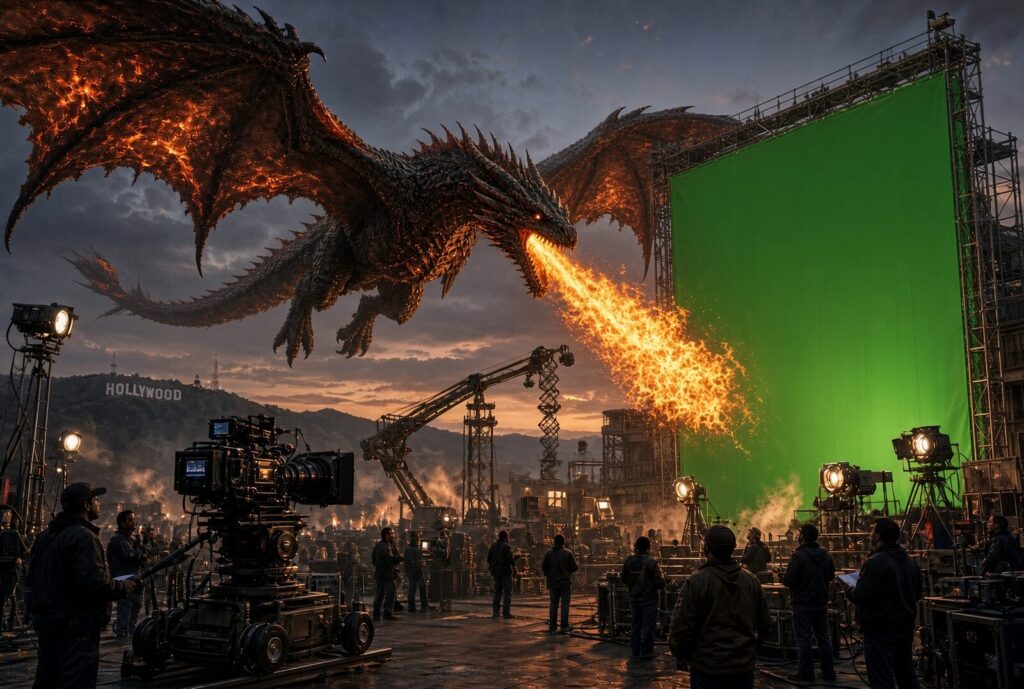
A good movie dragon is one of the hardest jobs in visual effects. It has to be huge. It has to fly. Most of the time it also has to act. Get any of these details wrong, and the audience stops believing.
These ten films got the dragon right. They run in release order, from ILM’s Draco in 1996 to Framestore’s Toothless in 2025. Read top to bottom and you can watch the tools change: custom facial software, then muscle simulation, then 20 million simulated hairs.
Budgets are the reported production budgets for the whole film, before marketing. Videos are official uploads only, from the film studio or the VFX studio that did the work. Where no official upload exists, we say so rather than embed a fan copy.
The 10 dragons at a glance
| Film | Year | Dragon | Budget | Dragon VFX |
|---|---|---|---|---|
| Dragonheart | 1996 | Draco | $57M | ILM |
| Reign of Fire | 2002 | The brood | $60M | The Secret Lab |
| Harry Potter and the Goblet of Fire | 2005 | Hungarian Horntail | $150M | ILM |
| Eragon | 2006 | Saphira | $100M | ILM, Weta Digital |
| Deathly Hallows: Part 2 | 2011 | Ukrainian Ironbelly | $250M (both parts) | Double Negative |
| The Desolation of Smaug | 2013 | Smaug | $217M to $250M | Weta Digital |
| Pete’s Dragon | 2016 | Elliot | $65M | Weta Digital |
| Shang-Chi | 2021 | Great Protector | $150M to $200M | Weta Digital |
| Dungeons & Dragons: Honor Among Thieves | 2023 | Themberchaud | $150M | MPC |
| How to Train Your Dragon | 2025 | Toothless, Red Death | $150M | Framestore |
1. Dragonheart (1996)
Budget: $57 million. The CG dragon alone reportedly cost about $22 million.
The dragon: Draco, voiced by Sean Connery
VFX studio: ILM, with VFX supervisor Scott Squires and animation supervisor James Straus. Design by Phil Tippett.
The tech: Caricature, ILM’s in-house facial animation system
Three years after Jurassic Park, ILM had to build a CG character that talks. Draco is on screen for about 23 minutes across 182 dragon shots. Jurassic Park had about six and a half minutes of CG dinosaurs.
Talking meant a face, and ILM had no tool for that yet. Software engineer Cary Phillips wrote Caricature for this film. Animators studied Sean Connery’s earlier performances and gave Draco his lip curls. Caricature later won an Academy Award for Technical Achievement, and ILM built its digital characters on it for years.
The film was shot in Slovakia. No bluescreen was used. Actors in front of Draco were separated by rotoscoping. Squires and Tippett were among the Oscar nominees for Best Visual Effects.
Watch it: Dragonheart on Prime Video | Dragonheart on Blu-ray
2. Reign of Fire (2002)
Budget: $60 million
The dragons: A brood that burns England to ash, led by one giant male
VFX studio: The Secret Lab, Disney’s in-house effects studio. The dead dragon prop was built by Artem.
The tech: A custom tool for covering the dragons in reptile scales
Director Rob Bowman wanted the dragons to behave like real animals, not movie monsters. They hunt, they fight each other, and the big male eats the smaller ones.
The hard part was skin. Lifelike scales across a creature that size were a real problem in 2002, so the effects team built a dedicated scale tool to handle it. The flying and fire still look good today.
The film was shot in Ireland’s Wicklow Mountains. It grossed $82 million on a $60 million budget, which counts as a miss. It has a cult following now, and plenty of people rank its dragons above the film around them.
No official studio upload of the Reign of Fire trailer exists on YouTube, so there is no video here.
Watch it: Reign of Fire on Prime Video | Reign of Fire on Blu-ray
3. Harry Potter and the Goblet of Fire (2005)
Budget: $150 million
The dragon: The Hungarian Horntail
VFX studio: ILM, with VFX supervisor Tim Alexander. Cinesite added arena shots.
The tech: A new fire simulation engine in ILM’s Zeno pipeline, plus cloth simulation for the wings
The Horntail chase was ILM’s main sequence on the film, around 140 shots. The digital dragon started as a scan of a physical maquette from the production art department.
The wings ran on ILM’s cloth simulation. Alexander said folding them shut was the hardest part. The fire was new. It came from a fire engine built out of ILM’s research work with Stanford, mixed with real flame elements. For the head movement, animators studied birds: the twitches, the cocked head, the sudden snaps.
Not every shot is digital. For the dragon in its cage, Nick Dudman’s creature team built a full-size head and neck that breathed real fire through a pair of jets. The work earned a VES Award nomination.
Watch it: Goblet of Fire on Prime Video | Goblet of Fire on Blu-ray
4. Eragon (2006)
Budget: $100 million
The dragon: Saphira, voiced by Rachel Weisz
VFX studios: ILM (VFX supervisor Samir Hoon) and Weta Digital (VFX supervisor George Murphy)
The tech: One dragon asset shared between two studios, and a motion-control flying rig
Director Stefen Fangmeier was an ILM visual effects supervisor before this, his first film as director. That shows. The story got savaged and the dragon did not.
The roughly 400 effects shots were split close to evenly between ILM and Weta. ILM built Saphira and handled her growing up, her bond with Eragon, and the flying. Weta took the opening dragon rider battle, Saphira’s growth flight through the clouds, and the armored final battle. ILM handed over its model and textures, and Weta used the model as it was. Two big studios sharing one hero creature like that is rare.
For the riding shots, ILM fed data from its animatics into a motion-control rig that actor Ed Speleers sat on, so his body moved with the dragon. It was one of the worst reviewed films of 2006. It still made about $250 million worldwide.
No official studio upload of the Eragon trailer exists on YouTube, so there is no video here.
Watch it: Eragon on Prime Video | Eragon on Blu-ray
5. Harry Potter and the Deathly Hallows: Part 2 (2011)
Budget: $250 million, shared with Part 1
The dragon: The Ukrainian Ironbelly that guards the vaults at Gringotts
VFX studio: Double Negative, now DNEG, with VFX supervisor David Vickery
The tech: The CG model turned into a full-size, machine-cut section of the dragon’s back for the actors
Most movie dragons are built to look powerful. This one was built to look abused. The brief was an emaciated, malnourished animal kept underground its whole life. Director David Yates wanted the audience to pity it and fear it at the same time.
DNEG started on the dragon in summer 2008, while the studio was still working on Half-Blood Prince. It delivered 410 shots on the film, including the Gringotts arrival, the cart ride, the vault and the escape across the Diagon Alley rooftops. In the dragon shots DNEG replaced the live-action set, which gave it full control over shadows and contact.
For the riding scenes, DNEG gave special effects supervisor John Richardson its finished Maya model. His team used it to CNC-machine a 12-foot, full-scale section of the dragon’s back for the actors to ride. In 2019 DNEG rebuilt the dragon for the Gringotts expansion of the Warner Bros. Studio Tour London.
Watch it: Deathly Hallows: Part 2 on Prime Video | Deathly Hallows: Part 2 on Blu-ray
6. The Hobbit: The Desolation of Smaug (2013)
Budget: Reported at $217 million to $250 million
The dragon: Smaug, voiced and performed by Benedict Cumberbatch
VFX studio: Weta Digital, with senior VFX supervisor Joe Letteri
The tech: Weta’s Tissue muscle system, the Synapse fluid solver for fire, plus Maya, Mari and RenderMan
Smaug is the one most people name first. Cumberbatch performed his scenes in a capture suit with a facial camera, and Peter Jackson directed him through them start to finish.
A human face does not map onto a dragon, though. The capture became reference, and Weta’s animators keyframed Smaug by hand. Under the scales, the Tissue system simulated muscle, from craning the neck to driving the wings into flight. Tissue later won a Scientific and Engineering Award from the Academy. A high-resolution face rig kept the scales intact while Smaug talked.
The fire came from Synapse, Weta’s in-house fluid solver, with World War II flamethrower tanks as reference. The treasure hoard needed over a billion simulated coins, with up to 100,000 moving in a single shot. The film had 1,951 effects shots in all.
Watch it: The Desolation of Smaug on Prime Video | The Desolation of Smaug on Blu-ray
7. Pete’s Dragon (2016)
Budget: $65 million
The dragon: Elliot
VFX studio: Weta Digital, with VFX supervisor Eric Saindon
The tech: Full fur simulation on 20 million hairs
Elliot breaks the rules. He is green and furry, not scaly, and he behaves like a giant dog. The remake swapped the 1977 hand-drawn dragon for a fully CG one.
The film has about 700 effects shots, and nearly all of them include Elliot. The Weta crew grew to about 200 artists. Saindon put the fur in numbers: King Kong in 2005 had a million hairs and Weta simulated about a tenth of them. Elliot had 20 million, and every one was simulated. When Pete grabs a fistful of fur, it reacts.
Early on, Weta decided to keep Elliot an animal. He does not talk. His fur also moved from a fluorescent green to a forest green that suits the woods he lives in.
Watch it: Pete’s Dragon on Prime Video | Pete’s Dragon on Blu-ray
8. Shang-Chi and the Legend of the Ten Rings (2021)
Budget: Reported at $150 million to $200 million
The dragon: The Great Protector
VFX studio: Weta Digital, now Weta FX, with VFX supervisor Sean Walker. Christopher Townsend was Marvel’s production VFX supervisor.
The tech: Path-based and keyframe animation on a spline rig, built in Maya and Mudbox, textured in Mari, rendered in Weta’s Manuka
The Great Protector is a wingless Chinese water dragon, and Weta had never built a dragon without wings. With no wings to flap, she leads with her head along a path. Animators then broke that path at the body so she looks like she is pushing through the air.
For her skin the team studied albino lizards, crocodiles and snakes. The scales are slightly translucent, so you can see blood under them. One modeler placed about 8,000 scales by hand. Her eyes were based on those of Fala Chen, who plays Shang-Chi’s mother.
Weta handled 305 shots in the third act battle, including the dragon, the Dweller-in-Darkness and the water. The film was nominated for the Oscar for Best Visual Effects. For more of Weta’s Marvel work, watch their Hawkeye Manhattan Bridge breakdown.
Watch it: Shang-Chi on Prime Video | Shang-Chi on Blu-ray
9. Dungeons & Dragons: Honor Among Thieves (2023)
Budget: $150 million
The dragon: Themberchaud
VFX studio: MPC, with VFX supervisor Axel Bonami. Ben Snow was the production VFX supervisor, and ILM handled many of the other creatures.
The tech: CG creature animation over live-action plates, inside MPC’s fully digital, lava-filled Underdark
Every other dragon on this list is scary or noble. Themberchaud is fat. Producer Jeremy Latcham said Wizards of the Coast pushed back on making him too chunky, and the filmmakers fought to keep him that way.
The weight is the joke and the design. He struggles to get airborne and slides down piles of bones after his dinner. He is still a fire-breathing red dragon that wants to eat the heroes. MPC delivered about 500 shots on the film, including Themberchaud and the Underdark caves around him.
Watch it: Honor Among Thieves on Prime Video | Honor Among Thieves on Blu-ray
10. How to Train Your Dragon (2025)
Budget: $150 million
The dragons: Toothless and the Red Death
VFX studio: Framestore, which handled all of the film’s VFX. Christian Manz was the production VFX supervisor.
The tech: Animatronic bucks on set for every dragon, CG backgrounds for the flying, and full previs, techvis and postvis
Universal was not sure a cartoon dragon would work in live action. Before the film was greenlit, Manz spent three months with Framestore’s animation and visual development teams proving a photoreal Night Fury could sell.
Toothless keeps his animated proportions and gets a photoreal surface. On set, each dragon had an animatronic buck with a moving head, neck and body that matched the animation cycles, so the actors had something real to touch. All of it was painted out afterward. The flying scenes use CG backgrounds so the camera can follow the dragons anywhere.
Framestore delivered over 1,400 shots, from concept art through final. The film grossed about $636 million worldwide. A sequel is set for June 11, 2027.
Watch it: How to Train Your Dragon on Prime Video | How to Train Your Dragon on Blu-ray
What the best ones have in common
A real performance at the center. Connery shaped Draco’s face. Cumberbatch’s capture drove Smaug. Even Elliot, who never speaks, was animated from a clear idea of what kind of animal he is.
Something physical on set. A fire-breathing Horntail head. A 12-foot section of dragon back. A moving buck for every dragon in How to Train Your Dragon. The digital dragon replaces it later, but the actors react to something real.
And new tools built for the job. Caricature, Tissue and Elliot’s fur system all started as problems no software could solve yet.
Want to see how shots like these come apart layer by layer? Start with our guide to what a VFX breakdown is. For more creature work, see our list of horror movies with heavy creature and environment VFX.
Where to watch
Streaming on Prime Video changes month to month. Some of these are included with a membership, others are rent or buy. If you do not have Prime, you can start an Amazon Prime free trial here. For the effects work, the Blu-ray releases are worth it. Several include making-of features you will not find on streaming.
This post contains Amazon affiliate links. We may earn a small commission on qualifying purchases at no extra cost to you. See our affiliate disclosure.

Leave a Reply