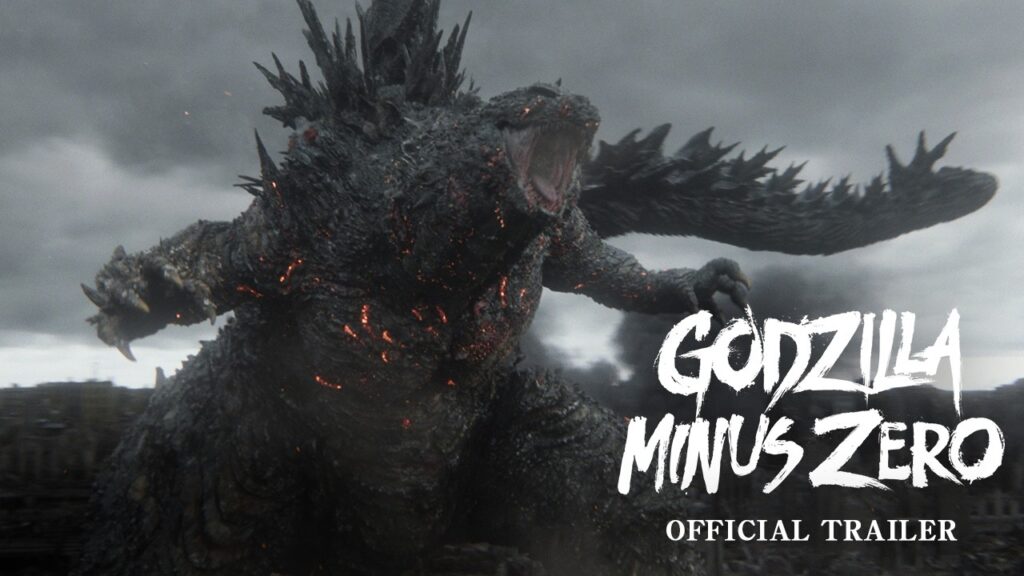
Toho just dropped the full 1.43:1 IMAX trailer for Godzilla Minus Zero. It runs 84 seconds. It pulled 1.7 million views in about five hours and landed at number 5 on YouTube’s trending movies chart. The tagline is blunt: “There is no third time. Everything ends here.”
Here is what we know about who is building the effects, plus a straight answer on the AI rumors already piling up on the internet.
What the Trailer Shows
The film picks up in 1949, two years after Minus One. Japan is rebuilding. Godzilla is not dead.
This one leans harder into science fiction than the first film did. You get a full scale extermination campaign, humanity throwing fire at atomic breath, and some genuinely strange geography, including what looks like a floating village. The final few seconds tease something else out there. Fans have already decided it is King Ghidorah. Toho has confirmed nothing.
Ryunosuke Kamiki and Minami Hamabe return as the Shikishima couple. Masami Nagasawa and Jun Kunimura join the cast. So do Hidetaka Yoshioka, Yuki Yamada, Kuranosuke Sasaki, Sakura Ando, and Miou Tanaka.
Key Dates
- World premiere: September 26, 2026 at the New York Film Festival (Spotlight Gala)
- Tokyo International Film Festival centerpiece: October 2026
- Japan release: November 3, 2026
- North America release: November 6, 2026
Runtime is reported at 135 minutes.
Why the IMAX Part Matters
This is the first Japanese production shot with the Filmed For IMAX certification. That means IMAX certified digital cameras, and select sequences that open up into the full 1.43:1 frame. That is the tall one, the format that fills your peripheral vision instead of letting you sit outside it.
It is not just a marketing line. It is a constraint. A bigger frame means more resolution, tighter tolerances, and every CG asset has to hold up under a lot more scrutiny. Nobody picks that format to make the job easier.
Principal photography ran August to December 2025. Locations included Ibaraki Prefecture (Tsukubamirai, Kasama, and Kuji), plus shoots in New Zealand and Norway.
The VFX Companies Behind It
Shirogumi is back. That is the house that made Godzilla Minus One, and right now it is the only VFX vendor confirmed on Minus Zero. Full vendor lists usually surface closer to release, so expect names to be added.
Takashi Yamazaki is once again writer, director, and VFX supervisor. That triple role is a big part of why the first film worked on the money it had. There is no translation loss between what the director wants and what the vendor delivers, because they are the same person.
It helps to remember what that team pulled off last time. On Minus One:
- 35 artists, 610 VFX shots, 8 months
- A budget under 15 million dollars
- zbrush for maquettes, maya and houdini for animation and effects, mudbox for displacement retopology, redshift for rendering, and nuke for compositing
- Godzilla’s head alone was roughly 200 million polygons, with another 100 million in the chest
It won the Oscar for Best Visual Effects in 2024. That was the first Japanese film ever nominated in the category. Minus Zero has a bigger budget, though Toho has not said how much bigger.
So Did They Use AI?
Short answer: there is no evidence they did, and nobody involved has claimed otherwise.
Toho, Shirogumi, and Yamazaki have made no public statement about generative AI on this production. The articles floating around about AI and the future of Godzilla are editorial speculation. They quote nobody from the film.
A few things push against the theory:
- The known pipeline is conventional. Minus One was maya, houdini, redshift, and nuke. Nothing in the Minus Zero reporting suggests a different approach.
- IMAX is the opposite of a shortcut. Large format shooting adds engineering overhead. It is a strange choice for a team trying to cut corners.
- Generative video still cannot do this. Sustained photoreal kaiju destruction, matched across a whole sequence, at IMAX resolution, with a consistent character design, is not what current text to video models produce reliably.
Here is the distinction most online arguments miss.
Machine learning has been part of VFX pipelines for years. ML denoising in renders. Assisted rotoscoping. Tracking. Cleanup. Upres. Foundry has shipped machine learning tools inside nuke for a while now. Almost every major effects film touches some of this.
That is not the same thing as AI generated. When somebody says a shot looks like AI, they usually mean it looks soft, or the motion reads wrong, or the composite did not sell. Those are craft problems, and they have existed for as long as CG has.
So take the accusations with a grain of salt. Wait for the breakdowns, which Yamazaki’s team has historically been generous about releasing.
Which VFX Houses Are Actually Using AI
Since the question comes up constantly, here is the real landscape as of 2026.
- DNEG and Brahma: DNEG spun its AI work into a separate company called Brahma, which acquired deepfake specialists Metaphysic in February 2025. Brahma now runs more than 800 engineers and creative technologists. On the VFX side, DNEG runs comfyui in a customized environment and has posted openings for Gen AI Workflow Designers and Model AI Artists. Job listings name runway, kling, luma, midjourney, and stable diffusion.
- Weta FX: Announced a partnership with AWS on December 2, 2025 to build artist first AI agents. The framing is deliberate. These are tools that behave like physics solvers or rigging systems, not prompt boxes. CTO Kimball Thurston put it plainly: “We’re not talking about chatbots replacing craftsmanship.” Their models train only on Weta’s own proprietary and synthetic data, with no scraped internet content.
- Framestore: Built an in house tool called Futon that folds machine learning and generative AI into the pipeline. Also runs FUSE, their Unreal shot engine, and fARsight for previs staging. They hired Theo Jones as Creative Director of AI.
- Digital Domain: The veterans here. Masquerade for facial capture, Charlatan for machine learning driven face work and de-aging. That tech built Thanos, de-aged David Beckham, and recreated Teresa Teng. Hanno Basse said of She-Hulk: “we don’t believe we could have delivered that many shots without it.”
- Rising Sun Pictures: Used learned reference libraries to build the digital baby in Thor: Love and Thunder.
- Crafty Apes: De-aging, facial manipulation, rotoscoping, and style transfer.
- Lux Aeterna: Machine learning for cleanup and roto, plus improved ML denoising to cut render times.
- Rodeo FX: Working on AI accelerated animation.
- Tippett Studio and Phantom Digital Effects: Blending analog craft, CG, and AI techniques on Phil Tippett’s Sentinel.
- Beeble AI: Relighting. It turns flat 2D footage into relightable PBR assets.
- Foundry: Ships machine learning nodes inside nuke, which puts trainable tools in front of compositors at basically every studio.
The Part Nobody Has Solved
Training data. A lot of generative models were trained without authorization on films and content produced by VFX and animation studios, including work DNEG did on Dune. That is why the Weta and AWS proprietary data only position is a real differentiator and not just public relations.
The pattern across the industry is consistent. Studios are using machine learning aggressively for the tedious middle of the pipeline: roto, cleanup, denoise, simulation assist, and face work. They are far more cautious about generative tools producing final imagery, mostly because of rights, provenance, and client contracts.
Bottom Line
Godzilla Minus Zero looks like a bigger, stranger, more expensive version of what Shirogumi already proved it could do on a shoestring. Shot for IMAX, which reads like confidence rather than corner cutting. For more giant creature work, see our list of horror movies with heavy creature VFX and the best CGI dragons in movies.
No AI claims. No AI denials. Just a very small team that has done this before, now working at a much larger scale. November 6.
Leave a Reply