Update: Since this post ran, Paramount settled with the states on September 21, and its Warner Bros. Discovery purchase was set to close October 6. Get the latest in our Skydance and Warner Bros. post.
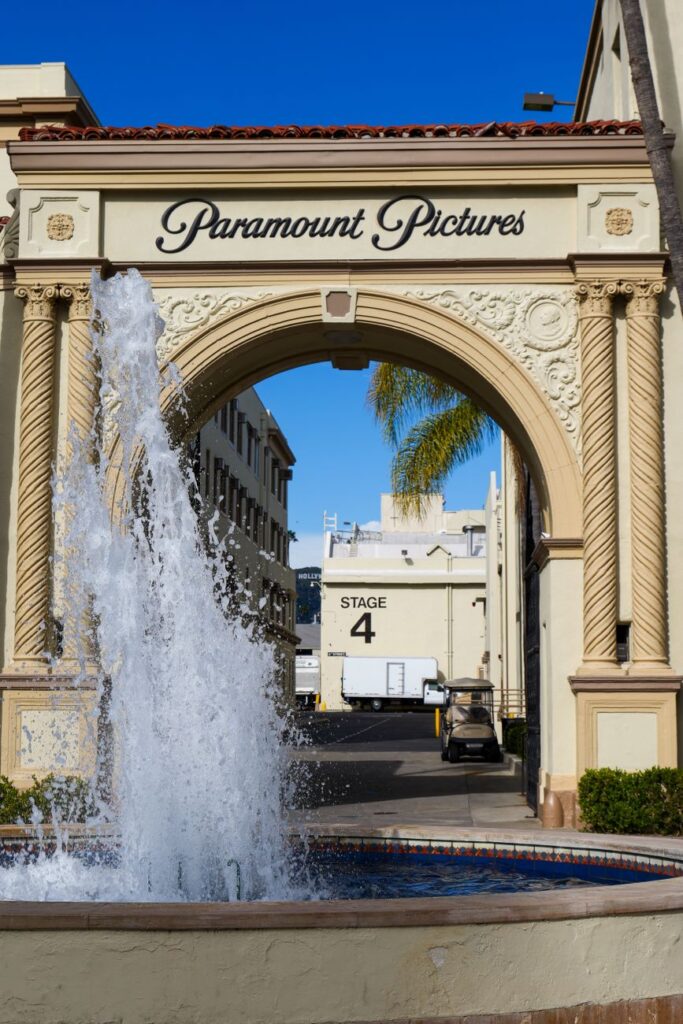
Paramount has been making movies on the same patch of Melrose Avenue since 1926. Right now the company is telling California officials it may pack up and go. That is not a rumor from a fan site. It came from the Attorney General’s office and the Mayor’s office.
If it happens, it is the biggest structural change to Hollywood in decades. So let’s walk through what is actually going on, what Paramount has meant to visual effects over the last hundred years, and what a move would really do to jobs in Los Angeles.
What is actually happening
Paramount is now Paramount Skydance, run by CEO David Ellison. Skydance closed its takeover of Paramount in 2025. Since then Ellison has gone after a much bigger prize: Warner Bros. Discovery, in a deal valued around $110 billion.
That deal is at an impasse. California Attorney General Rob Bonta and roughly a dozen other state AGs sued to block it on antitrust grounds. The list includes New York, New Jersey, Massachusetts, Colorado, Nevada, New Mexico, Oregon and Washington.
Ellison’s response was blunt. In August he said he would start pulling Paramount out of California on October 1 if the states would not come to the table. That date matters for a specific reason. Starting October 1, Paramount owes Warner Bros. Discovery shareholders roughly $7 million a day in “ticking fees” while the deal sits unclosed.
On September 16, reports said Paramount had notified both Bonta and LA Mayor Karen Bass that it was moving ahead. A formal announcement was expected that morning. It never came. As of this writing the company has not confirmed anything publicly.
Here are the other dates worth writing down. Settlement talks are set for October 14 and 15. A 12-day antitrust trial is scheduled for March 2027. The outside closing date on the merger is June 4, 2027, and a failed deal carries a $7 billion breakup fee.
The reported destinations are Nashville, Atlanta and Texas. Nashville keeps coming up because Oracle, co-founded by David’s father Larry Ellison, has been expanding there. Texas has no state income tax and already hosts Paramount’s Taylor Sheridan productions. Georgia has the studio infrastructure, with Trilith, Cinemaspace and Tyler Perry Studios all within reach of Atlanta.
It’s important to note. A lot of people in town read this as a pressure play, not a done deal. Larry Ellison ran a similar move in 2010, threatening to yank the America’s Cup out of San Francisco unless he got the waterfront development terms he wanted. He got them. Bonta’s office has called the current threat an attempt to pressure his office, and his public line has been short: what Paramount decides to do is Paramount’s choice alone.
Worth noting too: Paramount had earlier offered California a package to settle this, including a commitment to produce 30 films a year and keep both studio lots operating.
Paramount and visual effects: a hundred years on one lot
Whatever happens next, it is worth remembering what that lot has produced. Paramount is not just an old brand. For a long stretch it was one of the places where screen illusion got invented.
Paramount, 1920s – 1967
Studios used to own their effects. Paramount ran a full department, and it was very good.
Farciot Edouart ran process photography there for about 52 years. He is the reason so many classic Paramount scenes have actors in a car, or a plane, or a storm, without ever leaving the stage. He worked on roughly 350 films and collected ten Academy Awards along the way. His last credit was Rosemary’s Baby.
Gordon Jennings ran the effects side from 1932 until his death in 1953, with more than 180 films behind him and seven Oscars. The run is remarkable: Spawn of the North in 1938, I Wanted Wings in 1941, Reap the Wild Wind in 1942, When Worlds Collide in 1951, and The War of the Worlds in 1953, which he won after he died.
Then John P. Fulton took over the department and delivered the shot everybody still references. The parting of the Red Sea in The Ten Commandments in 1956. It won the Oscar.
It is worth knowing how that shot was actually built, because it is a compositing problem, not a water problem. A U-shaped trough was built on the Paramount backlot. Thousands of gallons were dumped into it and the footage was run in reverse, so the water appeared to pull apart. The standing walls of water came from an 80 by 32 foot concrete slide with valves and wooden riffles, filmed sideways. The storm clouds were grey paint poured into clear water. Paul Lerpae pulled blue screen traveling mattes of the crossing Hebrews, Jan Domela painted mattes to hide the seams, and the whole thing was shot in VistaVision and assembled on an optical printer. Four or more layers, no computer. That is a comp.
Then in 1967 Paramount closed the department. That is the part worth sitting with, because it is the first version of the story we are living through now. The studio decided it did not need to own the tools. Everything since has been vendors.
The vendor era and the birth of CG
Star Trek: The Motion Picture in 1979 was a scramble. The original effects vendor fell behind and Paramount brought in Douglas Trumbull and John Dykstra to rescue the film. The V’Ger sequences that came out of that emergency are still some of the most ambitious optical work of the era.
Three years later came the big one. The Genesis Effect in Star Trek II: The Wrath of Khan is generally credited as the first fully computer-generated sequence in a feature film. It was made by the Lucasfilm Computer Graphics Division, the team that later became Pixar. Loren Carpenter’s fractal terrain and Bill Reeves’ particle systems both got their feature debut in that one minute of screen time. Every fire, dust and debris sim you have ever set up traces back to it.
Through the 1980s Paramount distributed the Indiana Jones films, which meant Paramount posters on ILM’s best work. Raiders of the Lost Ark won the visual effects Oscar in 1981. Indiana Jones and the Temple of Doom won in 1984.
The digital turn
Forrest Gump in 1994 won the Oscar for work most audiences never registered as effects. Gary Sinise’s legs were painted out shot by shot. Tom Hanks was composited into archival news footage. The feather flew on a digital path. That film taught the industry that invisible VFX could carry a drama, not just a monster movie.
Titanic followed in 1997, with Paramount handling domestic distribution and Digital Domain handling the ship. Digital water, digital extras, digital everything, and another effects Oscar.
From there the pattern is familiar. Transformers in 2007 pushed ILM into asset complexity nobody had attempted. Star Trek in 2009 did the same for lens-flare-soaked photoreal space. Interstellar in 2014 won the Oscar for Double Negative’s black hole, built with physicist Kip Thorne’s equations, which then produced actual published science.
And Top Gun: Maverick in 2022 is the modern statement of purpose. The film was sold as practical flying, and it was. It also carried about 2,400 visual effects shots, led by Ryan Tudhope at Method Studios. CG jets, digital cockpit replacements, plume and missile work, extended environments. The audience walked out convinced they had seen no effects at all. That is the job now.
So what happens to jobs?
The number getting quoted everywhere comes from a Los Angeles County Economic Development Corporation report. A full Paramount relocation would mean the permanent loss of roughly 29,000 to 58,000 full-time jobs statewide. Annual economic output losses land between $10.6 billion and $21.2 billion. State and local tax revenue takes a hit of around $1.17 billion.
Read that range carefully. The low end and the high end are not close, and that tells you how much guesswork is involved. Nobody is claiming Paramount directly employs 58,000 people in California. Those figures include supplier and induced effects: the caterers, the equipment houses, the lumber yards, the dry cleaners near the lot, the post facilities, the freelance crew who work a Paramount show three months a year.
Reporting suggests the plan starts with corporate headquarters and expands over about five years, with something like 30,000 positions in scope. On the Ellison side, the math is a projected $500 million a year in tax savings.
The bigger worry is real estate. Paramount’s Melrose lot has grown from 26 acres and four stages to 65 acres and 29 stages. It has the Blue Sky Tank and ten blocks of New York Street backlot. It absorbed the old RKO and Desilu stages in 1967, which means the stages that shot King Kong and Citizen Kane are still standing there. Reports put the value of the studio lots at up to $4 billion each. If those get sold and converted to housing or offices, LA does not just lose a landlord. It loses stage capacity that independent productions rent, and that capacity does not come back.
And what about VFX specifically?
Here is the honest answer. A Paramount headquarters move would hurt VFX less directly than it hurts below-the-line production crew, because most Paramount VFX work already left Los Angeles a long time ago.
Paramount has not owned an effects house since 1967. Its shows go to vendors, and those vendors follow rebates. Vancouver, Montreal, Toronto, London and Australia have been eating the work for years. Studios now budget assuming a blended incentive of roughly 25 percent, which lets them shop a show across several countries. That is the actual gravity in this industry, and it does not care where a corporate headquarters sits. For where VFX hiring stands now, see VFX jobs in 2026.
What LA would lose is the layer that still lives here. VFX supervisors and producers. Post supervisors. Editorial. The vendor satellite offices that exist mostly to be twenty minutes from a studio executive. Dailies and review sessions. The relationships that get a boutique shop its first sequence on a tentpole. Those depend on proximity, and proximity is exactly what a move removes.
It also lands on an industry that is already thin. FilmLA counted 4,711 on-location shoot days in the Greater LA area in the second quarter of 2026. That is down 12 percent year over year and about 36 percent below the five-year average. Compare it to the same quarter in 2019, which had 8,632. Feature film days alone were down almost 20 percent. All of 2025 was down 16.1 percent.
California’s counter-move, and its blind spot
California did respond to all this. On July 1, 2025 the state launched Program 4.0 of its film and TV tax credit. The annual pool went from $330 million to $750 million, a 125 percent jump, locked in for five years.
Program 4.0 also opened the door to animation, half-hour shows, multi-camera sitcoms and large competition shows. Base credits sit at 20 to 25 percent, with relocating TV series getting 40 percent for a first season.
There is a VFX provision, and VFX artists should know the details. Productions can claim an additional 5 percent uplift on qualified California visual effects spending. To get it, either 75 percent or more of the show’s worldwide VFX spend has to happen in California, or the California VFX spend has to be at least $10 million.
That is a real incentive, but look at the threshold. A 75 percent in-state requirement is a high bar for a tentpole that already has vendors in four countries. And standalone VFX and post services, meaning work not attached to a qualifying California production, still do not qualify on their own. Georgia, by contrast, has no cap and covers above-the-line costs.
The early results are mixed. The expanded credit has brought 170 films and shows to California, and 38 percent of TV drama production in Q2 2026 came from incentivized projects. Overall shoot days still fell.
What to watch
- October 1. The ticking fees start. If Paramount makes a formal announcement, expect it around here.
- October 14 and 15. Settlement talks. A deal here makes the whole relocation threat disappear.
- The lots. Watch for any listing, appraisal or zoning activity around Melrose. Corporate offices can move quietly. Sixty-five acres cannot.
- March 2027. The antitrust trial, if it gets that far.
Our read: this is leverage first and a relocation plan second. Moving a corporate headquarters to Nashville is easy. Moving a hundred-year-old production ecosystem is not, and Ellison knows it. The offer to make 30 films a year and keep both lots open says a lot about where the company would prefer to land.
But leverage only works if the threat is credible, and this one is credible enough that the Mayor’s office is treating it seriously. For anyone working in effects in Los Angeles, that is the uncomfortable part. The work has been migrating for twenty years. This would just be the loudest version of it.

Leave a Reply